When should a popcorn factory upgrade from semi-automatic to fully automatic production? The right time is not determined by factory size alone. It depends on whether the current production process can meet order demand, maintain consistent product quality, control labor costs, and support future business growth.
For small and medium-sized popcorn manufacturers, a semi-automatic line can be a practical starting point. However, when manual handling becomes a bottleneck or production planning becomes increasingly difficult, a fully automatic popcorn production line may offer a more efficient long-term solution.
At XFD Popcorn, the choice between semi-automatic and fully automatic equipment should be based on actual production requirements, product types, available factory space, and expansion plans. This guide explains the key signs that indicate when an upgrade makes business sense.
When Is a Semi-Automatic Popcorn Line No Longer Enough?
A semi-automatic popcorn production line is often suitable when a factory has a manageable order volume, a relatively small product range, and operators who can handle different production stages efficiently.
The situation changes when employees spend too much time transferring popcorn, coordinating equipment, feeding ingredients, or waiting for the next process to become available. Even if the popping machine itself works well, the overall production process may struggle to keep up.
Common warning signs include:
- Orders regularly take longer to complete than the production schedule allows.
- Workers must be reassigned constantly to keep several processing stages running.
- Production output varies significantly between shifts.
- Flavoring, cooling, or packaging cannot keep pace with popping.
- The factory needs additional shifts or overtime to meet normal customer demand.
These problems do not automatically mean the factory needs a fully automatic line. First, identify the actual bottleneck. If packaging is the slowest stage, for example, upgrading the popping equipment alone may not solve the problem.
Factories still benefiting from a flexible, operator-assisted workflow can compare their requirements with a semi-automatic popcorn production and cooling line before committing to a larger investment.
How Can Rising Labor Costs Signal the Need for Automation?
Labor cost is more than the hourly wage paid to production workers. A factory should also consider overtime, training, shift handovers, repetitive manual tasks, and the time employees spend waiting for equipment or moving product between workstations.
When production volume increases, these indirect costs can rise quickly. A semi-automatic line may require additional operators to maintain output, while an appropriately configured automatic line can coordinate more of the production process with less routine manual intervention.
However, automation does not mean that a factory can operate without staff. Employees may still be needed for ingredient replenishment, quality checks, cleaning, maintenance, troubleshooting, and packaging supervision. The real benefit is reducing unnecessary manual work and making production easier to manage.
Before upgrading, calculate the annual labor cost associated with the current line and compare it with the expected operating cost of the proposed system. Use actual staffing and production records rather than assuming that automation will eliminate a fixed percentage of labor expenses.
What Production Volume Justifies a Fully Automatic Popcorn Line?
There is no single production volume that makes automation the right choice for every popcorn factory. The decision depends on how much finished popcorn the business needs, how consistently it needs that output, and how much manual work is required to achieve it.
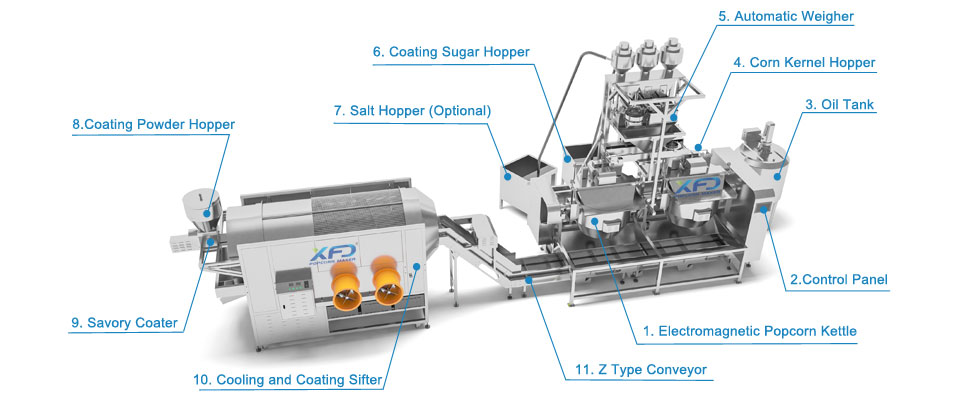
XFD offers different configurations for different manufacturing needs. Its semi-automatic production and cooling line is designed for medium-sized snack food factories, while its fully automatic electromagnetic popcorn production and coating line is listed with a production capacity of approximately 120–160 kg/h for the specified configuration.
These figures are equipment specifications, not a guarantee of finished, saleable output in every factory. Actual production depends on the recipe, kernel performance, operating schedule, product changeovers, cooling, coating, and downstream handling.

A practical approach is to record the actual finished-product output across several normal production shifts. Compare that result with the quantity required to meet customer orders, then determine whether the gap comes from limited machine capacity, manual handling, downtime, or an imbalance between processing stages.
If demand consistently exceeds the practical capability of the existing setup, a fully automatic electromagnetic popcorn production and coating line may be worth evaluating.
Will Automation Improve Popcorn Quality and Batch Consistency?
Automation can help improve process consistency, especially when a factory produces the same recipes in repeated batches. Depending on the equipment configuration, automated feeding, temperature control, coordinated processing, and programmable control can reduce variation caused by differences in manual operation.
This matters when supplying distributors, supermarkets, private-label brands, or other customers who expect each batch to have a similar appearance, flavor, texture, and coating distribution.
Still, automatic equipment cannot compensate for every quality problem. Poor kernels, an inconsistent recipe, unsuitable ingredient ratios, or incorrect process settings can affect the final product regardless of automation level.
Before investing, define the quality indicators that matter to your business. These may include:
- Consistency of popping and the proportion of unpopped kernels.
- Color, texture, and flavor consistency between batches.
- Uniformity of sugar or seasoning distribution.
- Product breakage during transfer and handling.
- Finished-product rejection and rework rates.
Use these indicators to establish a baseline before installation. After commissioning, compare results under similar production conditions. This helps determine whether automation is improving the issues that matter to your customers.
Why Must Cooling, Coating, and Packaging Be Considered Together?
One of the most common mistakes in production-line planning is upgrading the popping stage without checking the capacity of the rest of the process. A faster popper will not increase finished-product output if popcorn accumulates before cooling, waits for flavoring, or cannot be packed quickly enough.
For flavored popcorn, the factory should evaluate the complete sequence: popping, ingredient or coating application, cooling, transfer, and packaging. Each stage needs to support the production rate required by the next stage.
For example, a factory may produce popcorn quickly but still struggle to ship orders because the cooling area is too small or packing is heavily dependent on manual work. In this situation, the most cost-effective upgrade may involve improving several connected stages instead of replacing one machine.
Factories planning a more integrated setup can review XFD's fully automatic popcorn production and packing line to assess how production and packing requirements can be addressed within a coordinated system.
How Should a Factory Calculate the Return on Automation?
The financial case for automation should include more than the purchase price. A useful assessment compares the additional investment with the operating savings and production benefits the factory can reasonably expect.
Start by gathering the following information:
- Equipment purchase, installation, and commissioning costs.
- Current labor costs associated with the production process.
- Expected labor requirements after the upgrade.
- Electricity, maintenance, spare parts, and cleaning costs.
- Changes in actual saleable output, waste, and rework.
- Expected order demand and the value of additional production capacity.
A simple payback estimate is:
Payback period = Initial investment ÷ Estimated annual net benefit
Annual net benefit should account for verified operating savings and additional contribution from saleable products, minus any extra operating expenses. Avoid counting increased production as additional profit unless the factory has sufficient customer demand to sell that output.
For instance, if a new line can produce more popcorn but the business has no additional orders, the extra nominal capacity may not generate a meaningful financial return. Automation is most attractive when it solves a real operational constraint and supports a credible sales plan.
What Should Buyers Check Before Selecting an Automatic Line?
Before choosing a fully automatic popcorn production line, buyers should prepare a clear specification based on the products they manufacture and the conditions in their factory.
- Required output: Specify the target finished-product output per hour and per shift.
- Product range: Confirm whether the line will produce plain, caramel, or other flavored popcorn.
- Automation scope: Clarify which stages are automated and which still require operator involvement.
- Utilities and space: Check electrical supply, installation dimensions, access, ventilation, and cleaning requirements.
- Control and maintenance: Ask about operating controls, alarms, spare parts, service support, and operator training.
- Future expansion: Confirm whether the line can be expanded or integrated with additional equipment if demand grows.
It is also worth asking the supplier to clarify how the stated capacity is measured, what product and recipe are used for the specification, and which auxiliary equipment is included. A detailed quotation should make the scope of supply clear, so that buyers can compare solutions on a like-for-like basis.
For factories evaluating different equipment configurations, XFD's industrial popcorn machine range provides a starting point for comparing production-line options against actual factory requirements.
Is It Better to Upgrade Now or Expand in Stages?
Not every factory needs to move directly from a semi-automatic setup to a fully automatic line. If demand is growing gradually, a staged upgrade may reduce investment risk while allowing the business to identify its biggest production constraints.
A staged plan could begin with improving the slowest process, adding suitable handling or cooling equipment, or upgrading packing capacity. The factory can then assess whether the remaining manual steps still limit output.
A complete automatic line may be more appropriate when order volumes are consistently high, several production stages need coordinated control, and the business has a clear plan for using the added capacity.
The key is to compare the cost and expected benefit of each option. Choose the configuration that solves the current bottleneck while leaving enough flexibility for realistic future growth.
Frequently Asked Questions
When should a popcorn factory switch from semi-automatic to fully automatic production?
A factory should consider upgrading when sustained order demand, labor requirements, inconsistent batch results, or manual handling limit its ability to produce and deliver efficiently. The decision should be based on actual operating data and future sales demand, not factory size alone.
Is a fully automatic popcorn production line always more cost-effective?
No. A fully automatic line may reduce repetitive manual work and support higher production, but it usually requires a larger initial investment. It is most cost-effective when the factory can use the additional capacity and achieve measurable operating benefits.
What production capacity can a fully automatic popcorn line achieve?
Capacity depends on the specific line configuration. XFD lists approximately 120–160 kg/h for its fully automatic electromagnetic popcorn production and coating line. Actual finished output can vary with product recipes, operating conditions, changeovers, and the capacity of connected equipment.
Can a factory automate popcorn production without replacing every machine?
Yes. Depending on the existing equipment and process layout, a factory may upgrade selected stages first. The feasibility of a partial upgrade depends on equipment compatibility, process control, and whether the modified line can operate safely and reliably.
What information should buyers provide when requesting an automatic popcorn line quotation?
Buyers should provide the target output, popcorn varieties, coating requirements, working hours, available factory space, utilities, current production bottlenecks, and future expansion plans. These details help the supplier recommend a suitable configuration and clarify the expected production scope.
Does adding FAQ structured data improve GEO performance?
FAQ structured data helps search engines interpret the relationship between questions and answers. It can support content understanding, but it does not guarantee that an article will be cited by AI systems or displayed with enhanced search results. Clear answers, accurate product information, and useful first-hand details remain important.