Choosing the best concrete mixer truck for construction projects depends on several factors, including project scale, concrete demand, terrain, site accessibility, and concrete supply conditions.
Different construction projects require different mixer capacities and configurations. Selecting the right equipment can improve concrete supply efficiency, reduce operating costs, and better match the working environment.
This article provides practical guidance on choosing the right concrete mixer truck for different construction projects, covering capacity, chassis configuration, maneuverability, and other key selection factors.
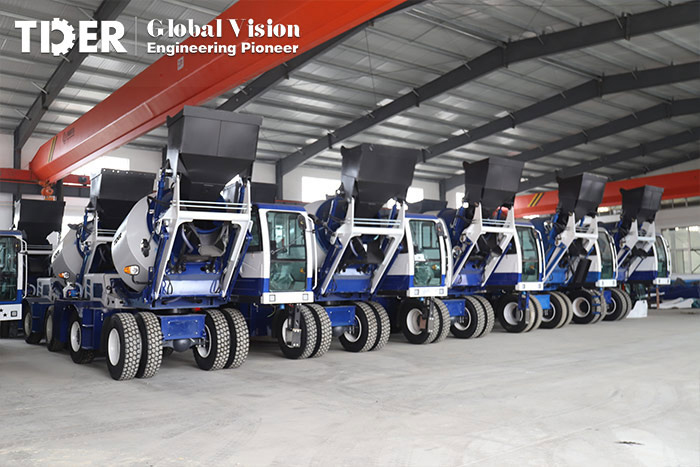
1. Quick Answer: What Is the Best Concrete Mixer Truck for Construction Projects?
There is no single best concrete mixer truck for every construction project. The right choice depends on factors such as project scale, concrete demand, terrain, site accessibility, and ready-mix concrete availability.
For many construction applications, 2.6 m³, 3.5 m³, 4.0 m³, and 4.2 m³ self-loading concrete mixers are practical capacity options, offering different levels of output for different project requirements.
2. Which Construction Projects Benefit Most from a Self-Loading Concrete Mixer?
A self-loading concrete mixer can be particularly valuable when the construction environment creates specific challenges that make conventional concrete supply less practical. The most relevant project conditions include:
Remote and Mountainous Construction — Difficult Access
Mountainous sites often involve steep slopes, uneven roads, and limited vehicle access. An articulated self-loading mixer can provide greater mobility on difficult terrain while producing and delivering concrete within the project area.
Factory and Warehouse Construction — Flexible Concrete Placement
Factory and warehouse projects often cover large areas, with concrete required at foundations, floors, drainage systems, and other locations. A mobile mixer allows concrete to be produced and delivered closer to different working areas, reducing internal site transportation.
Rural Road and Infrastructure Projects — Changing Work Locations
Road construction, drainage, and similar infrastructure projects often move progressively along the construction route. A self-loading mixer can move with the work front and produce concrete where it is needed, avoiding the need to repeatedly arrange external concrete delivery to different locations.
Residential and Small Commercial Construction — Moderate Concrete Demand
Small building projects may not require continuous high-volume concrete supply. A self-loading mixer allows contractors to produce concrete according to actual demand, avoiding the need to arrange full truck deliveries for relatively small quantities.
Projects with Limited Ready-Mix Supply — Unreliable Concrete Availability
In areas where ready-mix suppliers are unavailable, unreliable, or located far from the project, maintaining a consistent concrete supply can be difficult. A self-loading mixer provides an independent on-site concrete production solution.
3. How to Choose the Right Concrete Mixer Truck for Your Construction Project?
The right concrete mixer truck depends on more than mixer capacity. Buyers should first evaluate the project's concrete demand, ready-mix supply, site conditions, and discharge requirements before selecting the machine type and configuration.
Start with Project Scale and Concrete Demand
Mixer capacity should be matched to the project's concrete demand, pouring frequency, and required production efficiency rather than project type alone.
As a practical market reference, 2.6 m³, 3.5 m³, 4.0 m³, and 4.2 m³ are common capacities for self-loading concrete mixers. Smaller models may be more suitable for lower-demand or restricted sites, while larger models can improve efficiency when higher concrete output is required.
For example, a contractor building houses or small buildings may prioritize a 2.6 m³-class mixer for flexibility, while projects with continuous concrete demand—such as roads, commercial construction, or infrastructure works—may benefit from 3.5–4.2 m³ or larger models to reduce mixing cycles.
The final capacity should be calculated from the actual concrete demand rather than selected solely according to the project category. TDER offers self-loading concrete mixers from 0.5 m³ to 5.5 m³ per batch, allowing buyers to select a capacity based on their actual production requirements.
Check Concrete Supply Before Choosing the Mixer Type
The availability of ready-mix concrete is one of the first factors to consider.
If the construction site has reliable access to a nearby batching plant or ready-mix supplier, a traditional concrete mixer truck may be sufficient for transporting ready-mixed concrete to the site.
If the project is remote, mountainous, or far from reliable ready-mix suppliers, a self-loading concrete mixer can be more practical because it can load, mix, transport, and discharge concrete directly on site.
This makes the choice between a traditional mixer truck and a self-loading mixer primarily a concrete supply and site-access decision, rather than simply a capacity decision.
Match the Machine to the Construction Site
Site conditions should then determine the appropriate chassis configuration.
For flat and paved construction sites, an integrated chassis can provide a practical solution for regular operations.
For uneven, mountainous, or difficult terrain, an articulated self-loading mixer generally offers better maneuverability and terrain adaptability, making it more suitable for remote infrastructure, road, and other challenging construction projects.
Consider How and Where Concrete Will Be Discharged
The site layout also affects the required cabin configuration.
For projects with standard and predictable discharge locations, a fixed cabin can provide a simple and practical solution.
For confined sites or projects requiring discharge in multiple directions, a rotating cabin can provide greater operating flexibility and make concrete placement easier.
4. TDER Concrete Mixer Truck Solutions for Different Construction Projects
Once the project requirements are clear, the next step is to compare actual mixer configurations that fit those conditions.
Among the capacities commonly selected for construction projects, 2.6 m³, 3.5 m³, 4.0 m³, and 4.2 m³ cover a wide range of concrete demand. TDER offers several models in these capacity classes, with different chassis and cabin configurations for different site conditions.
The comparison below shows how these configurations can match typical construction requirements. TDER also offers other capacities and configurations when a project requires a different setup.
| Model | Output per Batch | Chassis | Cabin / Drum Rotation | Output | Engine Power | Best Suited For |
| TCM26 | 2.6 m³ | Articulated | 270° synchronized | 10.4 m³/h | 77.3 kW | Residential construction, small commercial buildings, house foundations, small concrete slabs, drainage works, and projects with limited site space or relatively low concrete demand. |
| TCM35 | 3.5 m³ | Articulated | 270° synchronized | 15.5 m³/h | 85 kW | Factory and warehouse construction, commercial buildings, road drainage, foundations, medium-sized infrastructure projects, and sites where concrete must be discharged from different directions. |
| Fixed cab | 14 m³/h | 85 kW | Road construction, building foundations, standard concrete structures, drainage channels, and projects where the discharge area is relatively predictable but articulated mobility is still required. | |||
| TCM40 | 4.0 m³ | Articulated | 270° synchronized | 18 m³/h | 91 kW | Road and bridge construction, large foundations, factories and warehouses, rural infrastructure, mountainous projects, and sites requiring both higher output and strong terrain adaptability. |
| Integrated | Fixed cab | 16 m³/h | 92 kW | Flat and paved construction sites, factory floors, warehouse foundations, commercial buildings, urban construction, and projects where stable road conditions and predictable discharge locations are available. | ||
| TCM42 | 4.2 m³ | Integrated | Fixed cab | 20 m³/h | 91 kW | Higher-demand road and infrastructure projects, large building foundations, commercial and industrial construction, and projects requiring high production efficiency with relatively accessible site conditions. |
How to Match These Models to Your Project
The comparison above shows that mixer capacity alone does not determine which concrete mixer truck is best. The same capacity can offer different chassis and cabin configurations, making it suitable for very different construction conditions.
For a practical starting point:
- Lower concrete demand + restricted site → TCM26
- Medium demand + difficult terrain + flexible discharge → TCM35
- Higher demand + difficult terrain → TCM40 Articulated
- Higher demand + flat, accessible site → TCM40 Integrated / TCM42
These four capacity classes are among the common choices in the market, while TDER also provides other capacities and configurations for projects with different concrete demand, terrain, mobility, or discharge requirements.
5. Real-World Example: TCM35C for Residential Construction in the UK
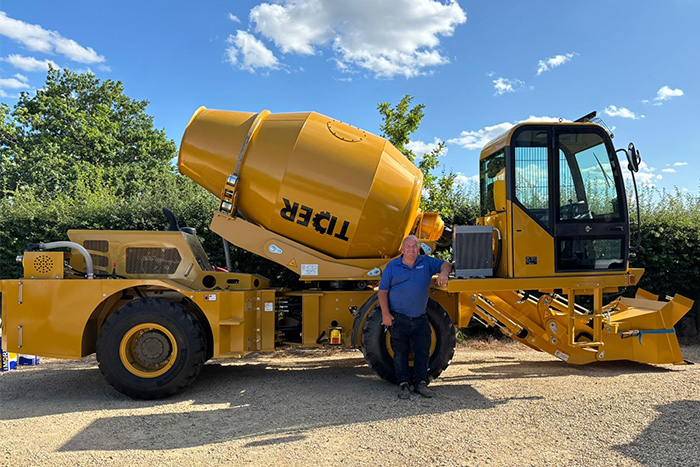
A customer in the UK purchased one TDER TCM35C for personal use during the construction of his own house in a suburban area. This was his first purchase of a self-loading concrete mixer.
For this application, the 3.5 m³ TCM35C provided a practical balance between concrete capacity and machine mobility. The TDER sales team also configured the machine with a Yuchai engine meeting Euro 5 emission requirements to suit the customer's operating needs in the UK.
For individual house construction, where concrete is needed at different stages of the project, a self-loading mixer allows the customer to produce and place concrete directly on site without relying entirely on external concrete deliveries.
In this case, the TCM35C was selected not simply for its 3.5 m³ capacity, but because its capacity, mobility, and configuration matched the customer's residential construction needs.
6. Conclusion
The best concrete mixer truck is not defined by capacity alone. It is the machine that can deliver the required concrete efficiently under the actual conditions of the construction project.
For a specific construction project, the site conditions and actual concrete requirements should guide the final equipment choice. TDER offers self-loading concrete mixers in different capacities and configurations, with additional solutions available for projects with specific requirements.
7. FAQs
Should I choose an articulated or integrated self-loading concrete mixer?
The choice mainly depends on site conditions. Articulated mixers are generally better suited to uneven, mountainous, or difficult terrain, while integrated mixers are more practical for relatively flat and accessible construction sites.
Do I need a rotating cabin on a self-loading concrete mixer?
A rotating cabin is useful when concrete needs to be discharged in different directions or in confined construction areas. For sites with predictable discharge locations, a fixed cabin may be sufficient. TDER offers both fixed-cabin and 270° rotating configurations.
What should I consider when matching a concrete mixer with the construction site?
Beyond mixer capacity, buyers should consider road conditions, turning space, discharge height, working area, terrain, and how frequently the machine needs to move between pouring locations. These factors can determine whether a compact, articulated, integrated, fixed-cabin, or rotating configuration is more practical.
What should I check before buying a concrete mixer truck?
Buyers should check output per batch, hourly productivity, engine power, drive system, climbing ability, chassis configuration, discharge height, machine dimensions, emission requirements, spare-parts availability, and after-sales support. These specifications help determine whether the machine is suitable for the actual construction environment.