A (also called a guardrail post driver, guardrail post pounder, or highway guardrail piling machine) is a construction machine that drives the vertical steel posts supporting roadside guardrail barriers. These posts — typically W-beam or thrie-beam guardrail supports — must be driven quickly, plumb, and at uniform spacing so the barrier can absorb vehicle impact and redirect traffic safely. Guardrail pile drivers are standard equipment for highway construction, road widening, and safety upgrades worldwide. For contractors tendering road-safety work, qualifying the right guardrail pile driver supplier and manufacturer matters as much as the hammer spec: proven field reliability, post-size versatility, and 24/7 after-sales often decide whether a tight highway window is met.
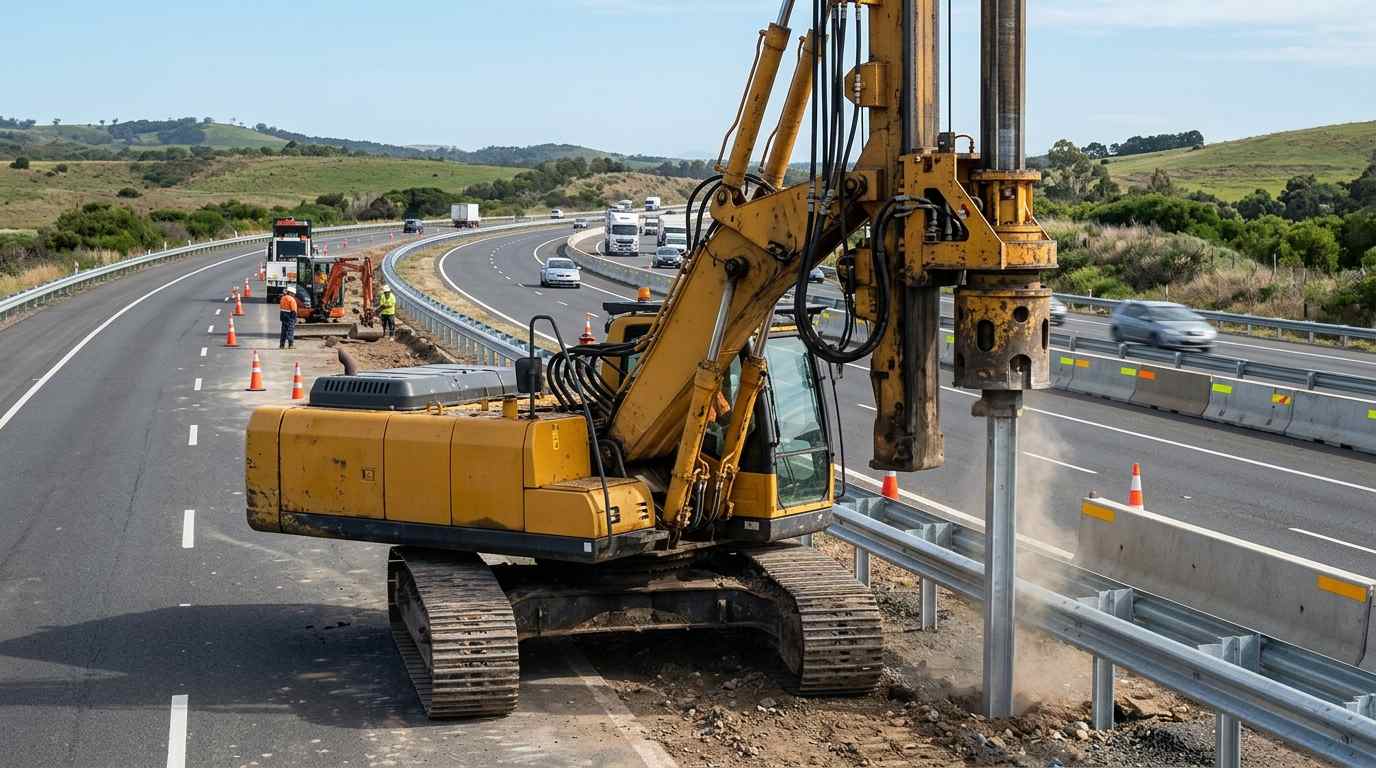
| W / Thrie Common guardrail post profiles |
High-freq Hammer type for fast post driving |
1 yr Typical machine warranty from OEM |
24/7 Technical after-sales support |
1. What Is a Guardrail Pile Driver?
A guardrail pile driver is a piling machine configured specifically for guardrail post installation. It is closely related to a solar pile driver but tuned for roadside work: it drives steel posts (often galvanized C-posts or I-beam posts) that the guardrail beam bolts onto. On highways, the barrier system is only as strong as its post foundation, so consistent driving depth and verticality are safety-critical.
Where guardrail barriers are used
- Highway medians and road edges (W-beam systems).
- Bridge approaches and bridge parapets (thrie-beam for higher containment).
- Steep-slope and curve protection where runoff vehicles must be contained.
- Work-zone temporary barriers during road construction.
TeZhong Machinery's TZ390 guardrail pile driver is a high-frequency driving unit that the company reports as its most recognized model in African road-safety markets, valued for rapid installation and post-size versatility. Like its solar stablemates, it is built as a multi-function platform rather than a single-purpose hammer.
2. Why a Dedicated Guardrail Driver Matters
- Safety compliance: Barrier posts must meet road-authority embedment and spacing specs; a purpose-built driver hits them repeatably.
- Speed on live roads: Highway work windows are short. Fast driving (high-frequency hammer) minimizes lane-closure time and traffic disruption.
- Precision: Integrated controls keep posts plumb and at uniform spacing for a continuous, code-compliant barrier line.
- Versatility: Many units also extract (remove) old posts and drill, supporting both new builds and retrofits.
- Lower lifecycle cost: A reliable unit with fast cycle time reduces crew hours per kilometer of barrier, improving bid competitiveness.
3. Main Machine Formats
| Format | Description | Best for |
|---|---|---|
| Wheeled / truck-mounted | Rubber-tire or vehicle-mounted driver for road mobility. | Long highway sections, frequent moves. |
| Crawler guardrail driver | Tracked chassis for stability on ungraded shoulders. | Remote or rough roadside terrain. |
| Trailer-type pounder | Towed unit with pneumatic/hydraulic hammer. | Smaller jobs, municipal work. |
Road contractors commonly standardize on wheeled units for long, continuous highway runs where the machine transfers between sections under its own power. Crawler variants earn their place where the shoulder is ungraded, soft, or sloped.
4. Guardrail Post Profiles & Spacing
The barrier's performance depends on the post as much as the beam. The most common configurations:
| Profile | Shape | Typical use |
|---|---|---|
| W-beam (two-wave) | Corrugated beam, C-post or I-beam support | Standard highways and median barriers |
| Thrie-beam (three-wave) | Deeper corrugation, stronger containment | Bridge approaches, high-risk curves |
| C-post | Cold-formed U/C channel | Most economical, widely specified |
| I-beam / tubular | Heavier section, deeper embedment | High-containment and terminal sections |
For W-beam systems, posts are commonly spaced 2 m, 3 m, or 4 m apart depending on the design level and terrain, following the local road authority's specification. The driver must hold that spacing and profile consistently across the whole run — which is why purpose-built guardrail equipment outperforms a generic piling rig adapted on site.
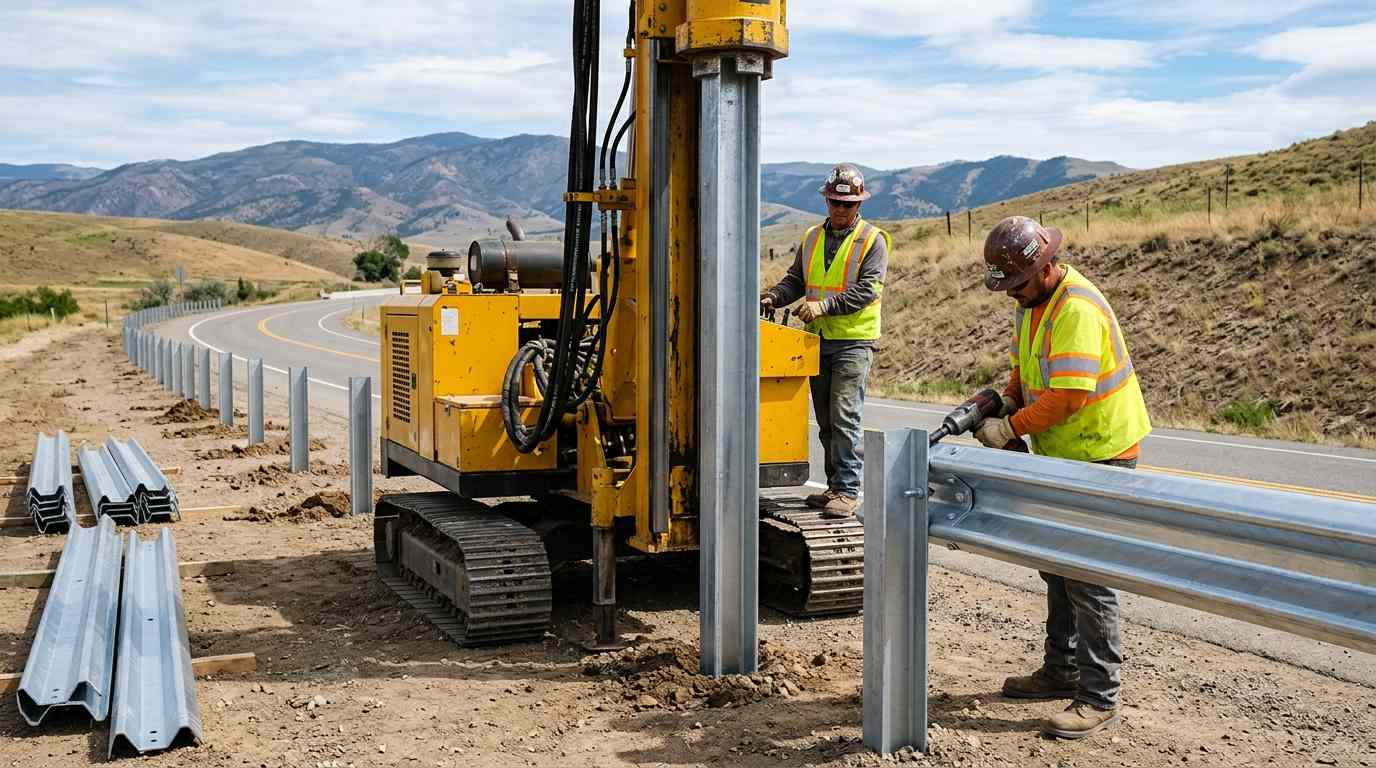
5. How a Guardrail Pile Driver Works
- Layout: Post centers are marked per the road design (typically 2–4 m spacing for W-beam).
- Position: The rig aligns the hammer over the marked point, often using a laser or guide.
- Feed & drive: The operator seats the post and the high-frequency hammer drives it to depth.
- Verify: Plumb and elevation are checked; the rig advances to the next post.
- Beam install: Once a run of posts is set, crews bolt the guardrail beam to the line of posts.
6. Guardrail Pile Driver vs. Solar Pile Driver
| Factor | Guardrail pile driver | Solar pile driver |
|---|---|---|
| Primary use | Roadside barrier posts | PV array foundation piles |
| Post type | C-post, I-beam, tubular (shorter) | C-post, H-beam, tubular (longer, deeper) |
| Spacing | 2–4 m, very uniform | Array grid, project-specific |
| Mobility | Often wheeled for road moves | Crawler common for fields |
| Extra functions | Ram + extract + drill | Ram + DTH + auger (3-in-1) |
Many hydraulic platforms share chassis technology but differ in hammer, mast, and tooling. A contractor doing both solar and highway work may standardize on one OEM's ecosystem. For the solar side, a dedicated solar pile driver is built for the high-volume, deep-grid foundations of PV arrays.
7. Key Components of a Guardrail Pile Driver
- Chassis & undercarriage — wheeled or tracked, sized for road transfer and roadside stability.
- High-frequency hammer — the core drive unit; frequency and blow energy set cycle time.
- Mast / guide rail — aligns and holds the post during driving for consistent plumb.
- Feed & clamp — seats and secures each post before impact.
- Power pack — diesel engine driving the hydraulics; on drill-capable units paired with an air compressor.
- Control & guidance — laser/plumb sensors and depth monitoring for repeatable, code-compliant installation.
Multi-function units add an extraction cylinder (to pull posts) and a drill head (to pre-bore in rock) alongside the ram — three jobs on one chassis.
8. How to Choose a Guardrail Pile Driver
| Checklist item | What to verify |
|---|---|
| Post profile | Confirm the machine handles your post shape/size (C-post, I-beam, tubular) and max length. |
| Hammer frequency | Higher frequency = faster driving on suitable soils; check blow energy too. |
| Mobility | Wheeled for long highway runs; crawler for unstable shoulders. |
| Dual function | Ram + extract + drill cover new builds and maintenance. |
| Support & warranty | 24/7 technical support and on-site commissioning reduce downtime on remote road jobs. |
9. Regional & Terrain Notes
- Arid / dusty (Middle East, North Africa): Enhanced air filtration and sealed hydraulics keep hammers productive.
- Rocky road cuts: A drill-capable unit pre-bores before ramming to avoid bent posts.
- Soft shoulders: Crawler chassis prevents sinking and keeps posts plumb.
- Cold regions: Cold-rated hydraulics and cabins maintain winter productivity.
10. Market & Applications for Guardrail Pile Drivers
Road-safety infrastructure is a steady, government-backed demand driver independent of the solar cycle. Key context for buyers and guardrail pile driver wholesale sourcing:
- Highway expansion: Emerging markets in Africa, the Middle East, and Southeast Asia are building and upgrading thousands of kilometers of expressway each year.
- Safety mandates: Rising crash-barrier standards push retrofits of older unprotected medians and bridge approaches.
- Post-disaster repair: Storm and accident damage creates recurring maintenance demand for extraction-and-reset work.
- Sourcing shift: More contractors buy direct from a guardrail post driver manufacturer rather than through trading resellers, to control lead time and cost.
11. Common Guardrail Installation Mistakes
- Wrong post profile for the spec — using C-posts where thrie-beam containment is required.
- Inconsistent spacing — drifting past the 2/3/4 m design spacing weakens the barrier line.
- Off-plumb posts — small angles compound and cause beam fit-up problems.
- Skipping extraction capability — forcing a second machine onto already-congested road works.
- Buying on price alone — the right guardrail pile driver supplier protects uptime with support, not just a low quote.
12. Frequently Asked Questions
13. Case Study: Highway Guardrail in Africa
TeZhong's TZ390 guardrail pile driver has been deployed by African contractors in three-person crews for road-safety upgrades, where its high-frequency driving and post-size versatility earned repeat orders. The model's recognition in the region reflects the value of fast, reliable post installation on infrastructure projects with tight timelines. Customers cited product quality and after-sales support as the reasons for re-ordering — a pattern that matters when a road-safety supplier is evaluated for multi-year framework contracts.
TeZhong Machinery is a China-based guardrail pile driver manufacturer and supplier (CE & ISO9001 certified) with ram/extract/drill functions and 24/7 technical support. As a direct factory we quote per post profile and project scale, so share your requirements for a configured recommendation.