You face two expensive risks. You may pay manufacturer prices through a trading company. Or you may receive a generator that fails under full load. Both problems surface after delivery, when your leverage is gone.
Choosing the right partner comes down to five verifiable factors: true factory status, power range and component quality, application fit, documented testing, and after-sales reach. Each one is checkable before you sign.
This article gives you a step-by-step supplier evaluation process. You also get a question checklist for your first email to any diesel generator manufacturer China shortlist. Send it early. Compare the answers side by side, and the real factory will stand out from the reseller.
Key Takeaways
-
Verify the supplier is a real factory, not a trading company, by checking business licenses and requesting a live video tour.
-
Match engine and alternator brands to your needs and confirm power ratings in writing before you buy.
-
Demand full documentation, including test reports and certifications, to ensure quality and compliance.
-
Secure after-sales support and spare parts availability in writing to protect your investment long-term.
-
Send a checklist of questions to shortlisted suppliers and compare their answers side by side to find the best partner.
Is Your Diesel Generator Manufacturer China Supplier a Real Factory?
The manufacturer vs trading company distinction shapes three things you will live with for years: pricing transparency, warranty accountability, and control over lead time. A direct factory sets its price from production cost. A trader adds a margin on top and may switch the factory behind your order. That switch changes your components, your testing standard, and your quality control record.
The table below shows how each exporter type behaves on price and warranty.
|
Exporter Type |
Pricing Transparency |
Warranty Accountability |
|---|---|---|
|
Factory-Direct OEM Manufacturer |
Best FOB price with no intermediary margin; pricing reflects direct production cost (only 5–10% above trading company on identical spec). |
Lowest warranty risk — direct relationship with the factory, which handles warranty claims itself and supplies parts from its own inventory. |
|
Authorised Export Agent |
Slightly above factory-direct; agent adds a 3–8% margin for the intermediary role. |
Medium risk — warranty flows through the agent to the factory, and claim resolution speed depends on the agent's ongoing factory relationship. |
|
Trading Company |
Can be lowest (sources from cheapest factory) or highest (layers of margin added); pricing is opaque and varies by which factory is used per order. |
Highest risk — the trading company must negotiate warranty with the actual factory, which may not honour a warranty on a unit sold through an unrecognised intermediary. |
A trading company can still be a legitimate route. What matters is that you know which entity builds the unit and which entity signs your contract. For long-term distribution, transparency beats the label a supplier gives itself. Ask for details on production facilities, assembly capability, testing procedures, and component origin.
Manufacturer vs. Trading Company
A direct manufacturer gives you production control, easier OEM customization, faster technical answers, quicker spare-parts matching, and one clear owner for quality. A trading company may offer broader product variety and mixed-container sourcing. You must still identify which factory is responsible for each model you buy.
A common sourcing mistake is to focus on the first container price and ignore after-sales support. A generator carries consumable and replaceable parts — air filters, AVR units, ignition coils, breakers, starter motors, and gaskets. Ask the factory how it identifies and supplies spare parts. A supplier that supports parts over several years is worth more than one with a slightly lower initial quote.
Documents and Factory Audits
Verification starts with paperwork. Request the business license, the ISO 9001 certificate, the CE Declaration of Conformity, OEM authorization letters, and load test reports. Then check each one against its issuer.
|
Document |
What It Proves |
How to Verify |
|---|---|---|
|
Business license (scope) |
Whether the company is a real manufacturer or a middleman |
The scope must explicitly state manufacturing/production of generator sets; if it only says sales, trading, or import/export, it is a trading company |
|
ISO 9001 certificate |
Quality management system covers generator set manufacturing |
Confirm the certificate number and certification body in the body's online registry, and check the certified scope and validity |
|
CE Declaration of Conformity + test reports |
The specific model ordered has been tested and conforms |
Request the DoC and underlying test reports for the exact model; a genuine manufacturer can produce them within 48 hours |
|
OEM authorization letters |
Genuine relationship with engine makers (Cummins, Perkins, Weichai, Yuchai) |
Ask for a current-year authorization letter; expired letters or vague partnership certificates do not count |
|
Load test reports |
Product performance and factory testing capability |
Request full load-bank test reports; buyers may also witness testing live or on-site |
Cross-check the factory address on the business license against the address on the ISO certificate. Confirm that one legal entity appears as the certificate holder, the manufacturer on the test reports, and the company on the proforma invoice. A stock exchange listing proves nothing about a specific plant. Verify that the listed company name matches the business license, then confirm the plant itself.
Next, audit the factory in person or through a live video walkthrough. Follow these steps:
-
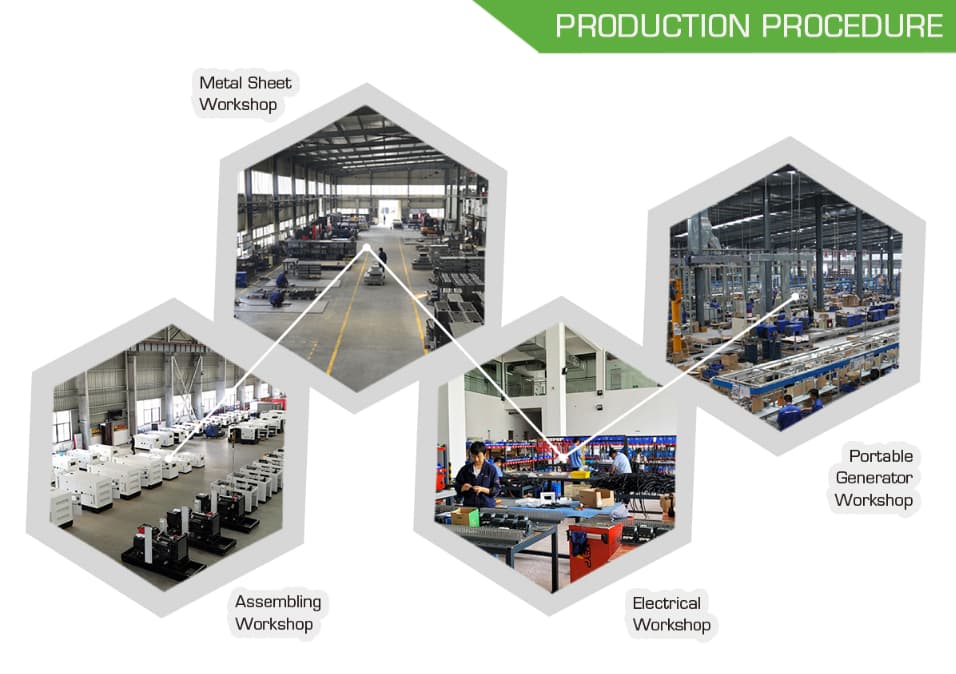
Ask for a live video tour of the production floor. A trading company cannot provide this.
-
Look for CNC equipment, organized assembly lines, and a dedicated test bay.
-
Watch for finished units only, with no cells, power supplies, or cabinets in production. That pattern points to a showroom or trader, not a real plant.
-
Search the company on 1688.com, China's domestic B2B platform, where real factories almost always maintain a presence.
Platform presence alone proves nothing. B2B platforms such as Made-in-China list both factories and traders side by side. A verifiable factory can supply a complete verification file on request — business license, ISO 9001 and CE documentation, OEM authorizations, and load test reports — and its certificates check out against issuer registries, with current OEM authorization letters from Cummins, Perkins, and Weichai.
Close this stage with three questions. Who owns the assembly line? Can we see the serial-numbered production log? Who signs the warranty? The answers separate a real china diesel generator manufacturer from a reseller. A capable diesel generator manufacturer in china welcomes these checks. Treat any hesitation as a signal, and move to the next candidate on your list.
Match Power Range and Components from a Diesel Generator Manufacturer in China
Quality varies by brand and configuration, not by country of origin. The "substandard Chinese generator" concern usually traces to off-brand engines, not Chinese manufacturing as a whole. A reputable diesel generator manufacturer china buyers trust will name every major component before you ask.
Start with the engine. Ask any china diesel generator manufacturer to confirm the engine brand and model in writing. Reputable engine brands to request include Cummins (China), Perkins (Wuxi), MTU, Volvo, Scania, Baudouin, Weichai, Yuchai, SDEC, FAWDE, Deutz, and Quanchai. A capable manufacturer stocks or sources several of these lines and matches each one to your duty cycle.
KEYPOWER serves as a useful benchmark for a full-range manufacturer. The factory spans over 66,000 square meters, has operated for 28 years, and runs an annual capacity of 5,000 units. Its diesel generator sets from china cover 6 kVA to 4375 kVA and remain compatible with Cummins, Perkins, MTU, Volvo, Scania, Baudouin, Weichai, and Yuchai. That breadth lets you compare engine and alternator options within one supplier instead of splitting an order across vendors.
Engine and Alternator Brands
The alternator deserves the same scrutiny as the engine. Brand choice affects voltage regulation, efficiency, transient response, insulation quality, and total cost of ownership. Global brands lower risk for critical power. Chinese brands offer strong value for cost-sensitive projects when you verify factory testing and certification.
|
Brand |
Origin |
Performance Notes |
|---|---|---|
|
Stamford |
UK (Cummins Generator Technologies) |
Reliable voltage regulation, good transient response, strong global service network; suited to critical power and data centers |
|
Mecc Alte |
Italy |
High efficiency, compact design, strong transient motor-starting; Class H VPI insulation; good for data centers |
|
ABB |
Switzerland/Global |
Heavy-duty, utility-grade; excellent for continuous operation in utilities, petrochemical, power plants |
|
Marathon Electric |
USA (Regal Rexnord) |
Robust construction, good load handling, low harmonic distortion, long service life; popular in mining, oil & gas, marine |
|
EvoTec |
China (German technology) |
Competitive price for high-voltage capability; requires verified factory testing and certification |
|
ENGGA |
China (Guangzhou) |
Common in Chinese OEM export sets; practical for large industrial projects with local support and competitive pricing |
Power Range and Ratings
Confirm prime versus standby ratings before you compare quotes. Prime rating supports continuous load at a variable duty cycle. Standby rating applies to emergency use at limited hours. A supplier that quotes one figure without labeling it invites oversizing or, worse, a generator that fails under load.
Demand named brands for the alternator and the controller. Accept Stamford, Leroy-Somer, or a named Chinese equivalent such as EvoTec or ENGGA. Reject "equivalent" language with no brand attached. The same rule applies to the controller: ask for the exact model, not a category. These technical specifications belong in the proforma invoice, and they anchor your quality control checks at acceptance. Strong manufacturing capability shows in precise answers, and that precision predicts reliability across the 15–20 year service life of your diesel generator set.
Test Application Fit and Customization Capability
A capable manufacturer asks detailed questions before quoting a diesel generator set. This consultation reveals whether the supplier understands your site or sells boxes. Expect questions about load profile, altitude, ambient temperature, fuel autonomy, and enclosure needs. A serious supplier reviews your load list with running values and confirms the duty rating: standby, prime, or continuous.
Ask about altitude and maximum ambient temperature. For sites above 1,000 meters or where ambient temperature regularly exceeds 40°C, request a derated rating. Specify fuel autonomy in hours at a stated load. Check the site for exhaust clearance, ventilation, and fit. Write a target sound pressure level in dBA at the property line.
Technical Consultation Quality
Application diversity separates experienced suppliers from generalists. Data centers, telecom, mining, oil and gas, healthcare, events, and water treatment each impose different demands. A supplier with real experience cites comparable projects. Technical answers predict the quality of the delivered diesel generator sets. A supplier that asks about your load profile will likely deliver a generator that performs.
Customization Scope
Probe the customization options available. Standard choices include voltage, frequency, and control settings; enclosure type and sound-attenuated canopies; fuel tank size and extended fuel tanks; ATS integration; paralleling controls; remote monitoring; and witnessed factory acceptance testing with a load bank.
|
Customization Category |
Options Available |
|---|---|
|
Electrical parameters |
Voltage, frequency, and control settings tailored to project requirements |
|
Control systems |
Custom control system configuration and project-specific settings |
|
Enclosure |
Enclosure type and design variations, including sound-attenuated canopies |
|
Fuel system |
Fuel tank size options and extended fuel tanks |
|
Power switching |
ATS integration |
|
Paralleling |
Paralleling controls for multi-unit operation |
|
Remote monitoring |
Remote monitoring capability |
|
Load bank testing |
Witnessed FAT with load bank (e.g., sustained 80% load for 60+ minutes) |
|
Branding/appearance |
Custom nameplates, labeling, paint color, branded packaging and manuals |
|
Documentation |
Localized documentation in the buyer's language |
Confirm every customization in the technical specifications. Customized generator sets should carry a written scope. Every generator should carry a test report, and the generator you receive should match the quoted scope. This protects both sides and keeps the industrial generator sets aligned with your project.
Review Documentation from Your Diesel Generator Manufacturer
Paperwork separates a serious supplier from a hopeful one. Request the full document set before you discuss price. A capable diesel generator manufacturer china partner supplies these items without delay:
-
ISO 9001 and ISO 45001 certificates
-
CE marking, plus CCC where your market requires it
-
OEM collaboration documentation covering Cummins, Perkins, MTU, and Mitsubishi relationships, with bidding document support
-
Full technical documentation to support customs clearance and regulatory compliance
-
A factory test report for every unit: load bank test, insulation resistance, and fuel consumption at 50, 75, and 100 percent load
Certifications and Test Reports
Verification takes three steps. First, confirm the certificate holder name matches the factory name on your proforma invoice. Second, identify the issuing body and confirm it is accredited. Third, validate each certificate number in the issuer's online registry. A certificate that fails any step proves nothing about your supplier.
Treat international compliance certifications as entry requirements, not selling points. Ask which certificate covers the exact model you plan to buy. A generic company certificate does not prove your generator sets passed testing.
In-House Testing Procedures
A manufacturer with its own load bank line demonstrates test capability directly. KEYPOWER offers load banks as a product line, so the factory can run witnessed tests on its own equipment. Ask to observe a load bank test during your audit. Watch the technician record kW, voltage, frequency, oil pressure, and coolant temperature at each load step.
Insulation resistance readings on the alternator windings belong in the report. Fuel consumption figures at each load step let you verify the datasheet claims. Strong production quality and testing shows in complete, signed records. Weak quality control shows in missing pages. Make documented testing a condition of your purchase order, and your quality control starts before delivery.
Evaluate After-Sales Support from a Diesel Generator Supplier in China
A generator runs for 15–20 years. The warranty period covers a small slice of that life. Your after-sales support and spare parts plan must cover the rest.
Warranty and Spare Parts
Get the warranty terms in writing before you sign. Vague promises cost you money at the first breakdown.
|
Warranty Dimension |
Typical Term |
|---|---|
|
Coverage period |
12 months from commissioning or 18 months from shipment, whichever comes first; longer terms negotiable |
|
Repair responsibility |
Repair or replacement for manufacturing defects under normal operation and maintenance; labor and travel inclusion to be specified |
|
Response time |
Response, fault diagnosis, and replacement-part dispatch times stated in the service-level agreement |
|
Spare parts lead time |
Stocked routine parts dispatched in about 3–10 business days; special components 4–12 weeks, excluding export documents, customs, and final-mile delivery |
Some suppliers calculate coverage by hours of use instead. One common formula counts 1,000 hours of use, 12 months from receipt, or 15 months from delivery, whichever comes first. Ask which formula applies to your generator sets.
Then ask about a recommended spares package. This package typically costs 2–5% of the unit value and includes filters, belts, and gaskets. Confirm the package is available locally. That step verifies real parts supply before you buy.
Local Service and Common Mistakes
Local reach decides how fast you recover from a fault. Ask for the nearest agent or overseas warehouse. KEYPOWER offers a useful benchmark here: offices, agents, and warehouses across more than 100 countries. A strong diesel generator supplier in china names its local partner and states a response time. Weak answers include "we support globally" with no name attached.
Buyers repeat a short list of mistakes. They choose on the lowest quote alone. They skip the factory audit, even though a video tour of build lines, load-test areas, and parts storage takes one call. They accept vague component descriptions. They ignore spare parts availability. They never confirm who honors the warranty. Any one of these errors erodes quality and reliability over the service life of your generator sets.
Send these questions to every shortlisted diesel generator manufacturer in china. Compare the answers side by side. A diesel generator manufacturer that answers precisely deserves your order. A china diesel generator supplier that dodges the questions does not.
Selecting a supplier is a verification process, not a price comparison. Confirm factory status, match components to your application, demand test documentation, and secure after-sales terms in writing. Each step protects your investment before the unit ships.
Send the checklist questions from this article to two or three shortlisted suppliers. Compare their answers side by side. A real diesel generator manufacturer answers precisely and welcomes a factory tour. A reseller hesitates.
Treat the decision as a long-term partnership. The right manufacturer supports your generator across its 15–20 year service life. Strong after-sales support and proven long-term operational reliability outweigh the lowest initial bid every time.
FAQ
How do I confirm a supplier actually builds generator sets?
Ask for the business license and check that its scope names generator manufacturing, not just sales. Request a live video walkthrough of the assembly line and test bay. Cross-check the factory address against the ISO certificate. A real plant answers all three requests without delay.
Which engine brands should I insist on?
Name the engine in writing before you compare quotes. Reputable options include Cummins, Perkins, MTU, Volvo, Scania, Baudouin, Weichai, Yuchai, SDEC, FAWDE, Deutz, and Quanchai. A capable supplier matches one of these lines to your duty cycle and confirms the model on the proforma invoice.
What test report should come with each unit?
Demand a factory test report per unit. It should record a load bank test, insulation resistance readings, and fuel consumption at 50, 75, and 100 percent load. Ask to witness a test during your audit. Missing pages signal weak quality control.
How long should the warranty last?
Typical coverage runs 12 months from commissioning or 18 months from shipment, whichever comes first. Some suppliers count 1,000 hours of use instead. Confirm the formula, the response time, and who performs repairs. Put every term in the contract.
What spare parts should I stock at the start?
Ask for a recommended spares package, usually 2–5% of the unit value. It covers filters, belts, and gaskets. Confirm the package ships locally. Routine parts typically dispatch in 3–10 business days, while special components take 4–12 weeks.