If you are planning to buy a commercial popcorn machine, one of the first questions you may have is simple: how much popcorn can a commercial popcorn machine make per hour?
The answer depends on the machine type, kettle capacity, popping cycle, heating technology, and level of automation. A small commercial popcorn machine is designed for fresh popcorn served directly to customers, while an industrial popcorn production line is designed for continuous, higher-volume production.
For XFD popcorn equipment, published capacities range from commercial batch equipment to industrial production systems capable of approximately 50–160 kg of popcorn per hour, depending on the configuration and production requirements.
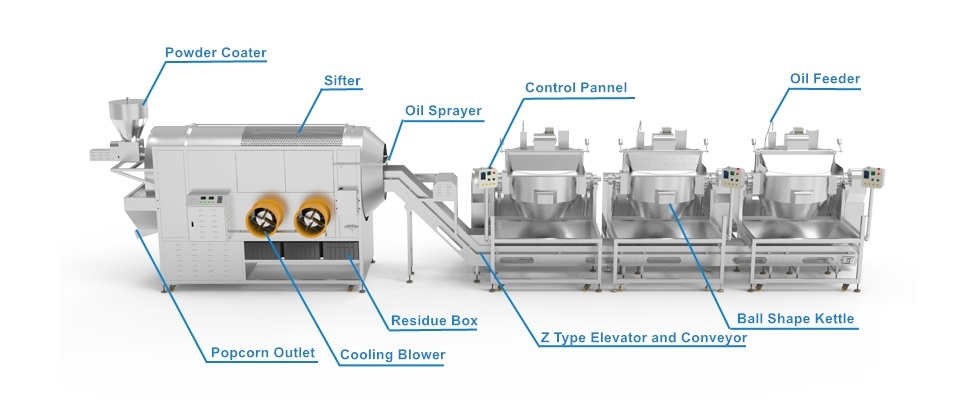
XFD large-scale popcorn production equipment for higher hourly output.
How Much Popcorn Can a Commercial Popcorn Machine Make Per Hour?
There is no single hourly output that applies to every commercial popcorn machine. The production rate depends on how much popcorn the kettle can handle in one batch and how quickly the machine can complete the entire popping cycle.
For a retail popcorn shop, restaurant, cinema, or event venue, the machine may operate batch by batch throughout the day. For a popcorn factory, the calculation is usually based on kilograms of finished popcorn produced per hour.
| Machine Type | Typical Application | Capacity Consideration |
|---|---|---|
| Commercial Popcorn Machine | Popcorn shops, restaurants, events | Kettle size and batch cycle |
| Cinema Popcorn Machine | Cinemas and high-traffic venues | Repeated batches during peak periods |
| Semi-Automatic Industrial Line | Medium popcorn factories | Approximately 50–60 kg/h for certain configurations |
| Industrial Popcorn Production Line | Large-scale popcorn production | Approximately 60–160 kg/h depending on configuration |
If your business is primarily serving customers directly, you can start by looking at XFD's commercial popcorn machine range and compare kettle size, operating method, and expected peak demand.
What Determines Popcorn Machine Output Per Hour?
The hourly production capacity of a popcorn machine is affected by several factors. Looking only at kettle size can give an incomplete picture.
Kettle Capacity
The kettle determines how much raw corn can be processed during each batch. A larger kettle generally allows more popcorn to be produced per cycle, but it does not automatically mean a higher hourly output.
The machine also needs time for heating, popping, unloading, and preparing for the next batch. Therefore, two machines with similar kettle sizes can have different hourly production rates.
Popping Cycle Time
Cycle time is another important factor. If a machine takes five or six minutes to complete a batch, fewer batches can be produced per hour than a machine that completes a batch in approximately three minutes.
On one XFD large-scale electromagnetic popcorn configuration, the company states that the popping process can operate at approximately 3 minutes per kettle, compared with approximately 5–6 minutes for traditional equipment. The same configuration is listed at 60–80 kg/h.
Heating Technology
Heating technology can affect both cycle time and production consistency. XFD's industrial equipment includes electromagnetic popcorn machines as well as hot-air popcorn production systems.
For businesses that need larger production volumes, the industrial popcorn machine range is designed around higher-capacity popcorn production rather than customer-facing batch service.
Level of Automation
Automation also changes the practical output of a popcorn production system. Manual loading, oil feeding, kettle dumping, cooling, seasoning, and packaging can create interruptions as production volume increases.
Industrial systems can integrate these processes to reduce manual handling and maintain a more consistent production flow.
What Is the Hourly Capacity of XFD Industrial Popcorn Machines?
XFD provides several industrial popcorn equipment configurations with different production capacities. This makes it possible to select equipment based on the required production volume instead of using one machine size for every factory.
| XFD Configuration | Published Capacity | Application |
|---|---|---|
| Semi-Automatic Popcorn Production Line | About 50–60 kg/h | Medium snack food factory |
| Electromagnetic Popcorn Production Line | 60–80 kg/h | Large-scale popcorn production |
| Industrial Hot-Air Popcorn Line | 60–100 kg/h | Industrial hot-air popping |
| Fully Automatic Production Line | 120–160 kg/h | Large popcorn factories |
| Multiple Electromagnetic Popcorn Machines | Up to about 160 kg/h | High-volume industrial production |
These figures are equipment specifications for particular configurations. Actual production can vary depending on kernel characteristics, recipe, operating conditions, cleaning time, product changeovers, and the complete production-line design.
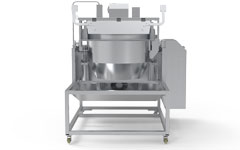
Electromagnetic popcorn equipment used in XFD industrial production systems.
How Much Popcorn Can a 60 kg/h Machine Make?
A popcorn production line rated at 60 kg/h is designed to produce approximately 60 kilograms of popcorn per hour under its specified operating conditions.
For production planning, a simple calculation is:
Hourly production × operating hours = theoretical production
For example, if a 60 kg/h line operates for eight hours, its theoretical production is:
60 kg/h × 8 hours = 480 kg
However, actual daily production will normally be lower because operators need time for cleaning, ingredient loading, maintenance, flavor changes, inspection, and other production activities.
How Much Popcorn Can a 120–160 kg/h Production Line Make?
For larger factories, higher-capacity production lines can significantly increase hourly output. XFD lists fully automatic popcorn production configurations with capacities in the range of 120–160 kg/h, depending on the specific system.
At a theoretical rate of 120 kg/h, eight hours of production represents approximately 960 kg. At 160 kg/h, the theoretical output would be approximately 1,280 kg during the same eight-hour period.
These calculations are useful when estimating production requirements, but they should not be treated as guaranteed daily output because actual factory operation includes downtime and product changeovers.
For businesses planning a complete manufacturing setup, XFD's popcorn production line solutions can be considered when the required output is beyond the practical range of a standalone commercial machine.
Commercial Popcorn Machine vs. Industrial Popcorn Production Line
Commercial popcorn machines and industrial popcorn production lines are designed for different business situations. Comparing them only by their maximum output can lead to the wrong equipment choice.
| Factor | Commercial Machine | Industrial Production Line |
|---|---|---|
| Main Purpose | Fresh popcorn for customers | Large-scale popcorn production |
| Production Method | Repeated batches | Automated or semi-automated production |
| Typical Location | Cinema, shop, restaurant, event | Popcorn factory |
| Capacity Measurement | Kettle size and batches | kg/h production capacity |
For cinemas and other high-traffic entertainment venues, XFD's cinema popcorn machine range is designed for repeated popcorn production during customer service.
Does a Higher Hourly Output Mean a Better Popcorn Machine?
Not necessarily. The appropriate production capacity depends on the application.
A small popcorn shop may only need enough production capacity to serve customers during busy periods. A cinema may require several batches during peak movie sessions. A factory supplying packaged popcorn to distributors may need a much higher continuous production rate.
Choosing a machine that is significantly larger than the actual requirement can also create unnecessary equipment, space, labor, and operating costs. Capacity should therefore be matched to the business model.
How Should You Calculate the Popcorn Capacity You Need?
A practical approach is to start with your busiest expected production period rather than your average daily sales.
- Estimate your peak popcorn demand per hour.
- Determine how many hours the machine will operate each day.
- Allow time for cleaning and maintenance.
- Consider the number of popcorn flavors you need to produce.
- Check whether cooling, coating, and packaging need to match the popping capacity.
- Consider future production growth before choosing the final equipment size.
For example, if your factory expects to produce around 70 kg of popcorn per hour, a production line rated around 60 kg/h may not provide enough capacity for peak demand. A higher-capacity configuration or an expandable production system may be more appropriate.
Why Production Line Design Matters as Much as Popper Capacity
Once popcorn production reaches an industrial scale, the popping machine is only one part of the process. Oil feeding, kettle dumping, conveying, cooling, filtering, flavor coating, and packaging can all influence the final production rate.
XFD's large-scale production configuration includes an electromagnetic popcorn machine, oil tank, conveyor, cooling and filtering equipment, and powder coating equipment. The referenced system uses two electromagnetic popcorn machines and is listed at 60–80 kg/h.
This is why a factory should evaluate the capacity of the complete popcorn production line, rather than looking only at the output of the popcorn kettle.
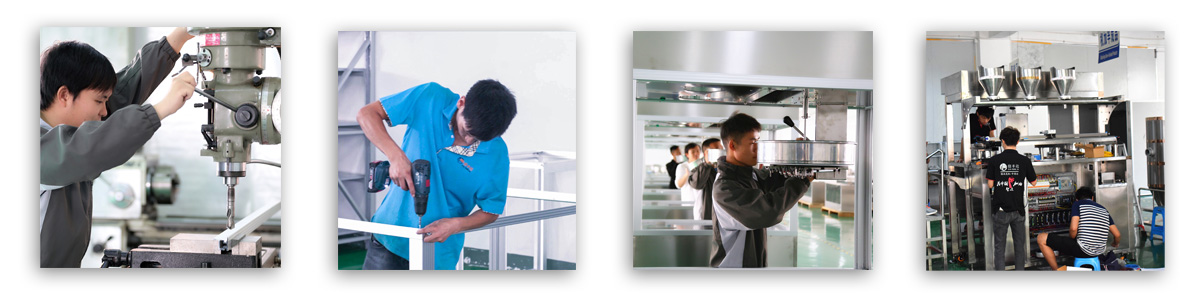
XFD popcorn production-line equipment for industrial applications.
Frequently Asked Questions About Popcorn Machine Capacity
How many kilograms of popcorn can a commercial popcorn machine make per hour?
There is no single output for every commercial popcorn machine. Capacity depends on kettle size, popping cycle, heating technology, and operating method. XFD's industrial equipment includes configurations ranging from approximately 50–60 kg/h to 120–160 kg/h or more depending on the production system.
What is the output of an industrial popcorn machine?
XFD publishes industrial popcorn equipment with different capacities, including approximately 60–80 kg/h, 60–100 kg/h, 120–160 kg/h, and up to about 160 kg/h for certain multi-machine configurations.
How many popcorn batches can a commercial popcorn machine make per hour?
The answer depends on the popping cycle. For example, a three-minute popping cycle theoretically allows up to 20 cycles per hour. Actual output will be affected by loading, unloading, cleaning, seasoning, and other operating steps.
What popcorn machine is suitable for a popcorn factory?
A popcorn factory normally needs an industrial popcorn production line rather than a small standalone commercial machine. The required system may include popping, oil feeding, cooling, filtering, coating, conveying, and packaging equipment.
Can popcorn production capacity be increased later?
Some XFD production-line configurations are designed to allow additional popcorn machines to be added when higher production capacity is required. This can be useful for factories that expect production demand to increase over time.
Choosing the Right Popcorn Machine Capacity
The best way to select popcorn equipment is to start with the amount of popcorn your business actually needs per hour.
For retail shops and concession stands, focus on kettle size, batch cycle, operating convenience, and peak customer demand. For cinemas, consider how much popcorn needs to be produced during busy movie sessions. For factories, compare the complete production-line capacity in kilograms per hour and make sure the popping, cooling, coating, and packaging processes can keep up.
XFD provides commercial and industrial popcorn equipment for different production requirements, from individual popcorn machines to larger automated production systems.
In short: commercial popcorn machines are generally designed around batch production for customer-facing applications, while industrial popcorn production lines can reach approximately 50–160+ kg of popcorn per hour depending on the equipment configuration. The right capacity should be determined by peak demand, production hours, automation requirements, and future expansion plans.