When choosing popcorn equipment, one of the first questions buyers often ask is: What is the difference between a commercial popcorn machine and an industrial popcorn machine?
The main difference is the scale of production. Commercial popcorn machines are generally designed for shops, cinemas, restaurants, concession stands, and other locations where popcorn is produced and sold directly to customers. Industrial popcorn machines and production lines are designed for larger-scale manufacturing, higher output, continuous production, flavor coating, cooling, and sometimes automatic packaging.
The right choice depends on your required output, production workflow, available space, labor, product types, and future production plans.
Commercial Popcorn Machine vs Industrial Popcorn Machine: Quick Comparison
| Factor | Commercial Popcorn Machine | Industrial Popcorn Machine |
|---|---|---|
| Typical application | Shops, cinemas, restaurants, events, concession stands | Popcorn factories, snack food manufacturers, large production facilities |
| Production scale | Small to medium production | Medium to large-scale production |
| Operation | Manual or semi-automatic | Semi-automatic to fully automatic |
| Production workflow | Usually focused on popping and serving | Popping, coating, cooling, conveying, and packing can be integrated |
| Space requirement | Relatively compact | Requires dedicated production space |
What Is a Commercial Popcorn Machine?
A commercial popcorn machine is designed for businesses that make popcorn on-site and sell it directly to customers. Common applications include cinemas, snack shops, restaurants, stadiums, amusement venues, bars, and concession stands.
Commercial equipment is usually easier to install and operate than a complete industrial production line. Depending on the model, it can use electric heating or electromagnetic heating technology and can be configured for different kettle sizes and production requirements.
For businesses that need a machine for a shop, cinema, or other commercial venue, the Commercial Popcorn Machine category from XFD provides different machine configurations for commercial applications.
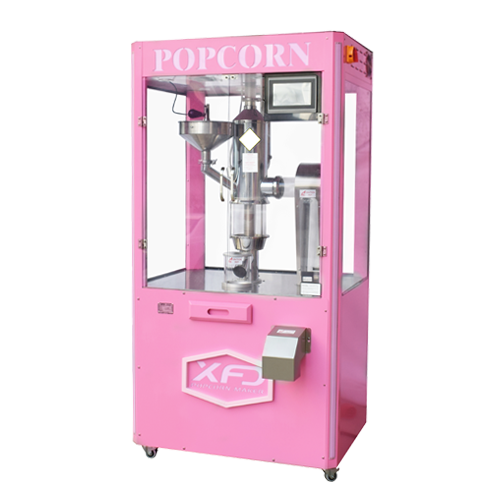
A commercial popcorn machine is usually the better choice when the main goal is to prepare fresh popcorn at the point of sale rather than manufacture large quantities for distribution.
What Is an Industrial Popcorn Machine?
An industrial popcorn machine is designed for higher-volume popcorn manufacturing. Instead of focusing only on popping, an industrial system can become part of a complete production workflow that includes feeding, popping, coating, cooling, conveying, separating, and packing.
Industrial equipment is commonly used by popcorn manufacturers, snack food factories, food processing companies, and businesses supplying packaged popcorn to retailers or distributors.
XFD offers a range of Industrial Popcorn Machines and production systems that can be configured according to required output and production processes.
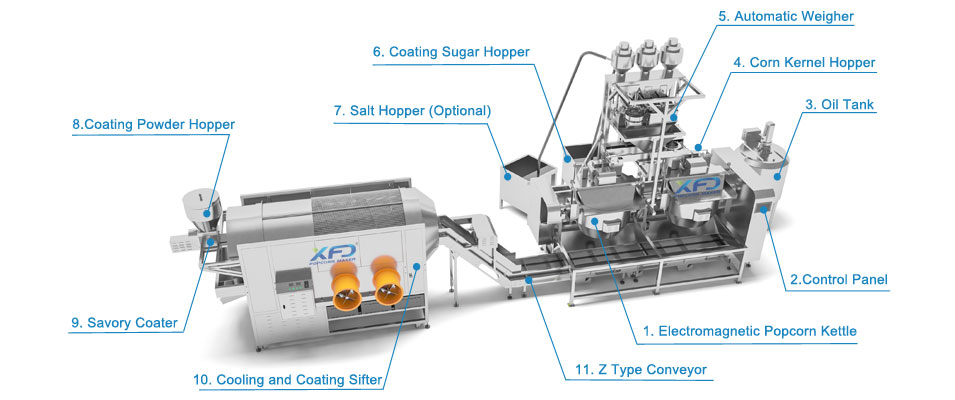
For example, XFD's fully automatic popcorn production and coating line uses electromagnetic heating technology and is designed for large-scale factory production. The product page states an output of approximately 120–160 kg per hour, depending on the configuration.
The Biggest Difference Is Production Capacity
Production capacity is one of the clearest differences between commercial and industrial popcorn equipment.
A commercial popcorn machine normally produces popcorn in batches that are suitable for customer-facing operations. The operator can prepare popcorn according to the actual demand of the venue, which helps avoid unnecessary production and equipment complexity.
An industrial popcorn line is designed around a much larger and more consistent production requirement. Multiple popcorn machines, automated feeding systems, coating equipment, cooling equipment, and conveyors can work together to increase overall throughput.
For example, XFD lists industrial solutions ranging from individual industrial popcorn machines to multi-machine production lines. Its website also describes industrial electromagnetic production lines that can be configured for higher output.
How Does Automation Differ?
Commercial popcorn production usually involves more direct operator participation. An employee may add ingredients, monitor the popping process, remove the finished popcorn, and prepare it for sale.
Industrial popcorn production can automate many of these steps. Depending on the system, automatic feeding, oil feeding, kettle dumping, temperature control, coating, cooling, conveying, and packaging can be integrated into one workflow.
This is especially useful when the factory needs to maintain consistent production throughout a long working period. XFD's industrial production lines use PLC control systems and can integrate automatic feeding, oil systems, kettle dumping, alarm systems, and other production functions.
Commercial Equipment Is Not Simply a Smaller Industrial Machine
It is tempting to think of a commercial popcorn machine as a smaller version of an industrial popcorn machine. In practice, the two are designed around different business models.
A commercial machine needs to be convenient for point-of-sale production. The operator may need to see the popcorn being produced, serve customers quickly, clean the equipment between production periods, and move or rearrange equipment as the business changes.
An industrial system is designed around production efficiency. The priority is usually stable output, repeatable processing, reduced manual labor, integration with downstream equipment, and the ability to scale production.
Therefore, choosing the largest machine available is not always the best solution. The equipment should match the actual production requirement.
What About Popcorn Coating and Flavoring?
Another important difference appears when the business produces flavored popcorn at scale.
For a commercial popcorn shop, flavoring may be handled manually or with a compact coating machine. XFD also offers Popcorn Coating Machines for businesses that need a more consistent coating process.
For industrial production, coating can be integrated directly into the production line. Popcorn can move from popping to coating, cooling, and subsequent processing with less manual handling.
This type of workflow is particularly useful for caramel popcorn, chocolate popcorn, cheese popcorn, flavored popcorn, and other products where consistent coating is important.
Which Popcorn Machine Should a Small Business Choose?
If you operate a popcorn shop, cinema, restaurant, concession stand, bar, or event business, a commercial popcorn machine is usually the more practical starting point.
Commercial equipment can provide the production capacity needed for direct customer sales without requiring the space and infrastructure of a complete factory production line.
When comparing models, consider:
- Kettle size and expected production per batch
- Expected daily popcorn demand
- Available operating space
- Electric or electromagnetic heating technology
- Ease of cleaning and maintenance
- Whether caramel or flavored popcorn will be produced
- Whether production may increase in the future
For commercial applications, you can review XFD's commercial popcorn equipment and compare different configurations according to your business requirements.
When Should You Choose an Industrial Popcorn Production Line?
An industrial popcorn production line becomes more appropriate when popcorn is being manufactured as a packaged food product rather than simply prepared for immediate sale.
Typical situations include:
- You need a high and consistent hourly output.
- You supply popcorn to supermarkets or distributors.
- You manufacture multiple popcorn flavors.
- You want to reduce manual handling.
- You need integrated coating and cooling processes.
- You plan to add automatic packaging equipment.
- You expect production demand to increase over time.
For these applications, an industrial popcorn production system can provide a more scalable solution than using multiple standalone commercial machines.
Can a Commercial Popcorn Machine Be Used in a Factory?
In some cases, commercial machines can be used for small-scale production or product testing. However, they are generally not the most efficient solution for a factory that requires continuous high-volume production.
A factory should consider the complete production process rather than looking only at the popping machine. Feeding, popping, flavoring, cooling, conveying, storage, and packaging can all affect the actual production capacity.
For example, XFD's industrial popcorn solutions can combine popcorn popping with coating and other downstream processes, allowing the equipment to be designed around the required production workflow.
How to Choose Between Commercial and Industrial Popcorn Equipment
The simplest way to choose is to start with your business requirements rather than the machine itself.
Choose commercial popcorn equipment if you mainly produce popcorn for immediate customer consumption and need a compact, easy-to-operate solution.
Choose industrial popcorn equipment if you manufacture popcorn at factory scale, require higher output, need automated processing, or want to connect popping with coating, cooling, conveying, and packaging.
If your production requirement is between these two levels, a semi-automatic production line may also be worth considering. XFD provides different industrial popcorn production configurations, allowing the number of machines and production capacity to be adjusted according to the customer's requirements.
Frequently Asked Questions
What is the main difference between commercial and industrial popcorn machines?
The main difference is the intended production scale. Commercial popcorn machines are designed for shops, cinemas, restaurants, and other customer-facing businesses, while industrial popcorn machines are designed for higher-volume factory production and can be integrated into automated production lines.
Are industrial popcorn machines fully automatic?
Not every industrial popcorn machine is fully automatic. Industrial equipment can range from individual machines and semi-automatic systems to fully automatic production and coating lines. The appropriate automation level depends on the required output and production workflow.
How much popcorn can an industrial machine produce per hour?
Production capacity varies by machine type and configuration. For example, XFD's fully automatic popcorn production and coating line lists an output of approximately 120–160 kg per hour, while other industrial configurations have different capacities.
Can industrial popcorn equipment make flavored popcorn?
Yes. Industrial popcorn production lines can be configured for flavored popcorn production, including coating processes using sugar, powders, caramel, and other flavoring materials. XFD's industrial production lines are designed for popcorn production and coating applications.
Is a commercial popcorn machine better for a popcorn shop?
For most popcorn shops, yes. A commercial popcorn machine is generally more appropriate when popcorn is produced directly at the point of sale and the required output does not justify a factory-scale production line.
Can I upgrade my popcorn production capacity later?
Yes, depending on the equipment configuration. Industrial popcorn production systems can be designed with additional machines or downstream equipment to increase production capacity. XFD also describes industrial production lines that can be configured according to required output.
Final Takeaway
The choice between a commercial popcorn machine and an industrial popcorn machine mainly depends on where the popcorn is produced, how much popcorn you need to make, and how much of the production process you want to automate.
For cinemas, shops, restaurants, events, and other point-of-sale applications, commercial popcorn equipment is usually the more practical option. For factories and packaged popcorn manufacturers, industrial equipment provides greater production capacity and more opportunities to integrate popping, coating, cooling, conveying, and packaging into one production workflow.
Before selecting equipment, define your target hourly output, popcorn flavors, available space, labor requirements, and expected future production. This will make it easier to select the right popcorn machine or production line for your business.